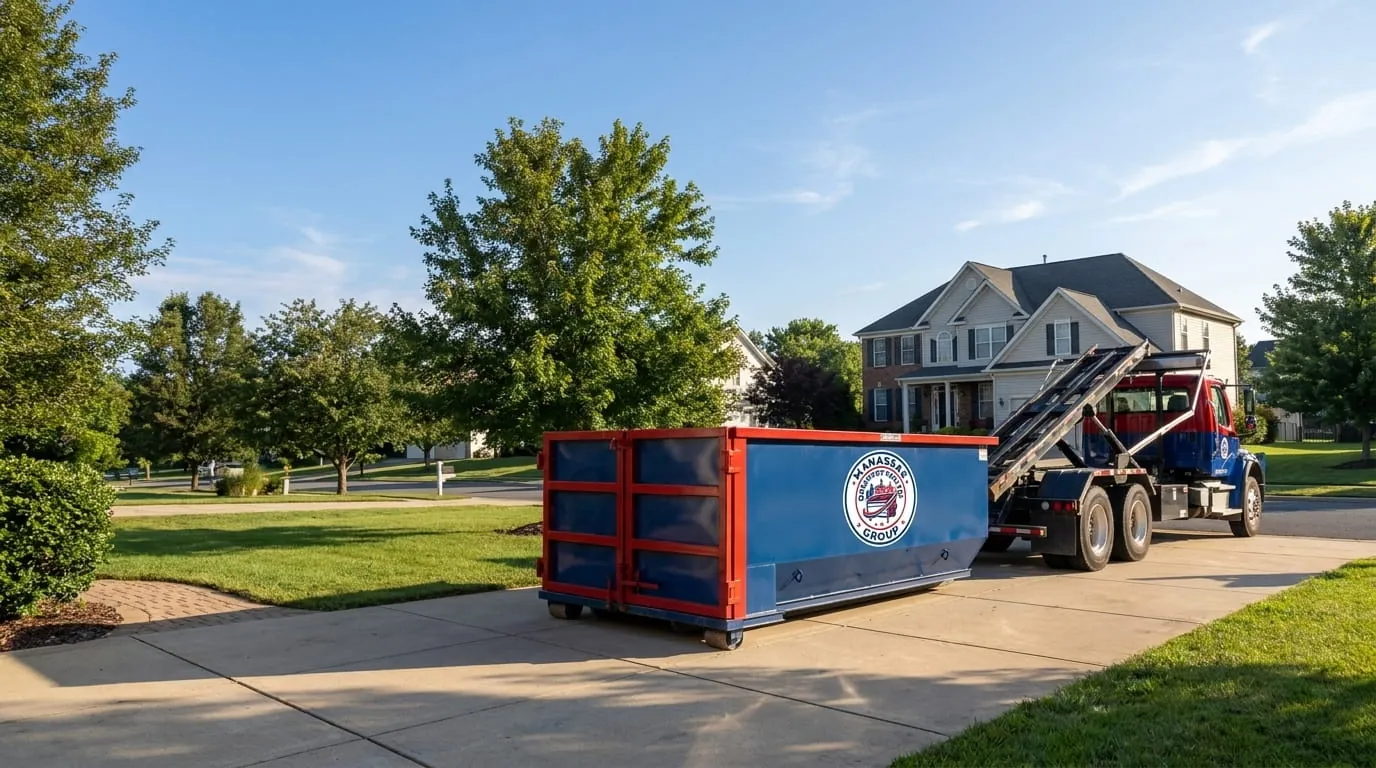
I have set a lot of roll-off dumpsters on a lot of driveways around Manassas, and I can tell you the driveway is almost always the thing homeowners forget to think about until the truck is already in the street. People plan the project. They price the container. They line up help for the weekend. Then the loaded box sits on their brand-new asphalt for nine days in the middle of a July heat wave, and by the time it leaves there are two dark rectangles pressed into the surface where the rear wheels sat. That does not have to happen. A little planning up front protects the most expensive flat surface most people own.
This is a walk-through of exactly what goes wrong, why it goes wrong, and how to stop it. It applies whether you have poured concrete, sealed asphalt, or old pavers, and it works the same in Old Town, Sudley, Bull Run, or out toward Nokesville.
Why a Roll-Off Is Hard on a Driveway
A roll-off dumpster is not gentle. Empty, a 15- or 20-yard container weighs somewhere in the range of 2,500 to 4,000 pounds. Fill it with shingles, broken concrete, or wet drywall and you can be looking at six, eight, even ten tons sitting on a handful of contact points. That load does not spread out evenly. It concentrates on the two rear wheels and the two front skids or feet at the back of the box.
So the whole weight of a project rides on maybe four small patches of your driveway. On concrete that usually means point loading that can chip or crack an edge, especially near a control joint or an existing hairline. On asphalt the problem is different and honestly more common. Asphalt is not rigid. It is a flexible material held together by bitumen, and bitumen softens when it gets warm. A heavy point load pressing into warm asphalt for a week will leave a permanent dent. Add the delivery and pickup, where the truck drags the box down on rollers and then winches it back up, and you have real scraping and gouging potential on top of the static weight.
The Fix Is Boards. That Is Basically the Whole Secret.
The single most effective thing you can do is put something between the container and your driveway. Wood spreads the load out over a much larger area, so instead of ten tons pressing on four small feet, it presses across several square feet of surface. That is the difference between a dent and no dent.
Here is what actually works, in order of how much I trust it:
- Two-by-tens or two-by-twelves under the rear wheels. Solid dimensional lumber, laid flat, is my first choice under the wheels because that is where the heaviest concentrated load lands. Use pieces long enough that the wheel sits in the middle with plenty of board on either side, not perched on the end.
- Three-quarter-inch plywood under the skids and feet. A full sheet or a couple of half sheets under the back feet of the container spreads that load nicely. Thinner plywood flexes and can crack, so do not go below three-quarter inch.
- A combination of both. Plywood underneath as a base layer, dimensional lumber on top under the wheels specifically. This is the belt-and-suspenders setup for a heavy fill on a nice surface.
You want the boards down before the container is set, not shoved under after the fact. Once eight tons is sitting there, nothing is getting slid underneath. This is a conversation to have with your rental company when you schedule delivery, not something to spring on the driver when he pulls up. A good company already carries boards on the truck and knows to ask.
Placement Matters as Much as Padding
Where the box sits changes how much stress it puts on the surface and how much it annoys everyone around you. A few things I always look at before deciding on a spot:
Stay off the edges. The edges of a driveway, both asphalt and concrete, are the weakest part. There is no lateral support out there, so an edge is far more likely to crack or crumble than the middle. Center the container on the driveway's structural body and keep the wheels off the outer twelve inches.
Mind the slope. Most driveways pitch down toward the street for drainage. On a slope the container wants to settle its weight toward the low end, and delivery and pickup get trickier. A relatively flat, firm section is ideal. If your whole driveway is steep, tell your rental company in advance so the driver can plan the approach.
Watch what is overhead and underneath. Low branches and power service drops can catch the raised bed of the truck during delivery. And soft spots, buried irrigation lines, septic components, or a shallow drain can all be damaged by concentrated weight. If you know something is under a section of the driveway or yard, keep the box off it.
Leave the swing room. The truck needs a straight, clear shot to back in and drop the box, plus room for the bed to tilt up. Move cars, trash bins, and the basketball hoop before the delivery window, not during it.
For most home projects a mid-size box on a standard two-car driveway is the sweet spot. If you are weighing which size fits your space and your debris, our 15-yard dumpster is the one I steer a lot of Manassas homeowners toward for garage cleanouts, single-room remodels, and roofing tear-offs, because it holds a real amount of weight without needing a huge footprint.
Heat, Cold, and Northern Virginia Weather
Manassas summers get hot and humid, and that matters more than people expect. On a 95-degree afternoon, fresh or recently sealed asphalt gets soft enough that you can press a thumbnail into it. Set a loaded box on that surface with no protection and it will sink in. Boards are non-negotiable in high heat. If your driveway was paved or sealcoated within the last year, be extra cautious, because new asphalt stays tender for months and is the single most common thing I see get dented.
Winter brings a different problem. Freeze-thaw cycles are hard on concrete already, and any existing crack can be pried wider by a heavy static load sitting through a cold snap. Standing water under a container that then freezes is another way to do damage. Year round, try not to leave a full container parked longer than you actually need it. The longer a heavy load sits, the more time it has to work into the surface.
Stains, Rust, and the Marks Nobody Warns You About
Weight is not the only way a dumpster marks up a driveway. Two more to plan for:
Rust and drip stains. Steel containers can leave rust marks where they contact the ground, and whatever you throw in can leach. Roofing debris drips tar. Demolition loads drip who-knows-what. Boards underneath catch a lot of this before it reaches your surface. A tarp or heavy plastic under the boards adds another layer of protection if you are working over decorative concrete or pavers you care about.
Scrape marks at delivery and pickup. The moment the box touches down and the moment it gets dragged back up onto the truck are when scraping happens. This is entirely about the driver's skill and whether protection is in place. An experienced operator sets the box down softly on the boards and winches it back up without dragging the bare steel across your surface.
What a Good Rental Company Actually Does
Property protection separates the outfits that care from the ones that just want to drop a box and move on. When you call around, this is what you should hear:
- They bring boards or plywood and offer to place them without being begged.
- The driver walks the spot with you before dropping, instead of guessing and backing in blind.
- They ask about your surface, your slope, and how new the driveway is.
- They set the box down gently and pick it up cleanly, no dragging.
- They are straight with you if the driveway genuinely cannot handle the load, and suggest the street or the yard instead.
That last point is worth sitting with. Sometimes the honest answer is that the box should not go on the driveway at all. A firm, level patch of yard or a legal spot in the street can be a better choice for a heavy fill on a delicate surface. A crew that tells you that is looking out for you.
If you want to talk through your specific driveway and project before you book, call us at (571) 518-5792 and we will tell you honestly what we would do. We handle a lot of residential dumpster rental across Prince William County, and we would rather spend five minutes on the phone getting the placement right than deal with an upset homeowner later.
HOA-Friendly Placement
Plenty of Manassas and Prince William neighborhoods run active HOAs, and dumpsters are exactly the kind of thing covenants have opinions about. A few habits keep you out of trouble:
- Check the rules before you book. Many HOAs allow roll-offs for a limited window, sometimes with a permit or a heads-up to the board. Knowing your limit lets you schedule delivery and pickup to fit inside it.
- Keep it on your property. On the driveway, protected by boards, is almost always more HOA-acceptable than parked in the street where it blocks sightlines and irritates neighbors.
- Order the right size. A box that fits your driveway without overhanging into the sidewalk or road reads as tidy and temporary. An oversized container that sticks out is what generates complaints.
- Keep the load below the rim and give the neighbors a courtesy heads-up. An overflowing, tarp-flapping eyesore draws attention. A neat, contained box that shows up and leaves on schedule rarely does.
A Simple Pre-Delivery Checklist
- Clear cars and obstacles from the driveway and the truck's path.
- Pick a flat, central spot off the edges.
- Have boards or plywood ready, or confirm the company brings them.
- Note anything buried or fragile under the surface.
- Check HOA rules and any street-placement permit requirements.
- In summer heat or on new asphalt, insist on protection under every contact point.
Do those six things and the odds of your driveway coming through untouched go way up. A dumpster is a tool. Used carefully, it makes a big job easy and leaves no trace. Used carelessly, it leaves marks you will look at every day for years. The difference is a few boards and a driver who gives a damn.
Have questions about your driveway or which container fits your project? Reach out through our contact page or give us a call, and we will help you plan a delivery that protects your property from the first minute.

Founder, Manassas Dumpster Rental Group — sharing straight advice from more than 15 years of local hauling experience.