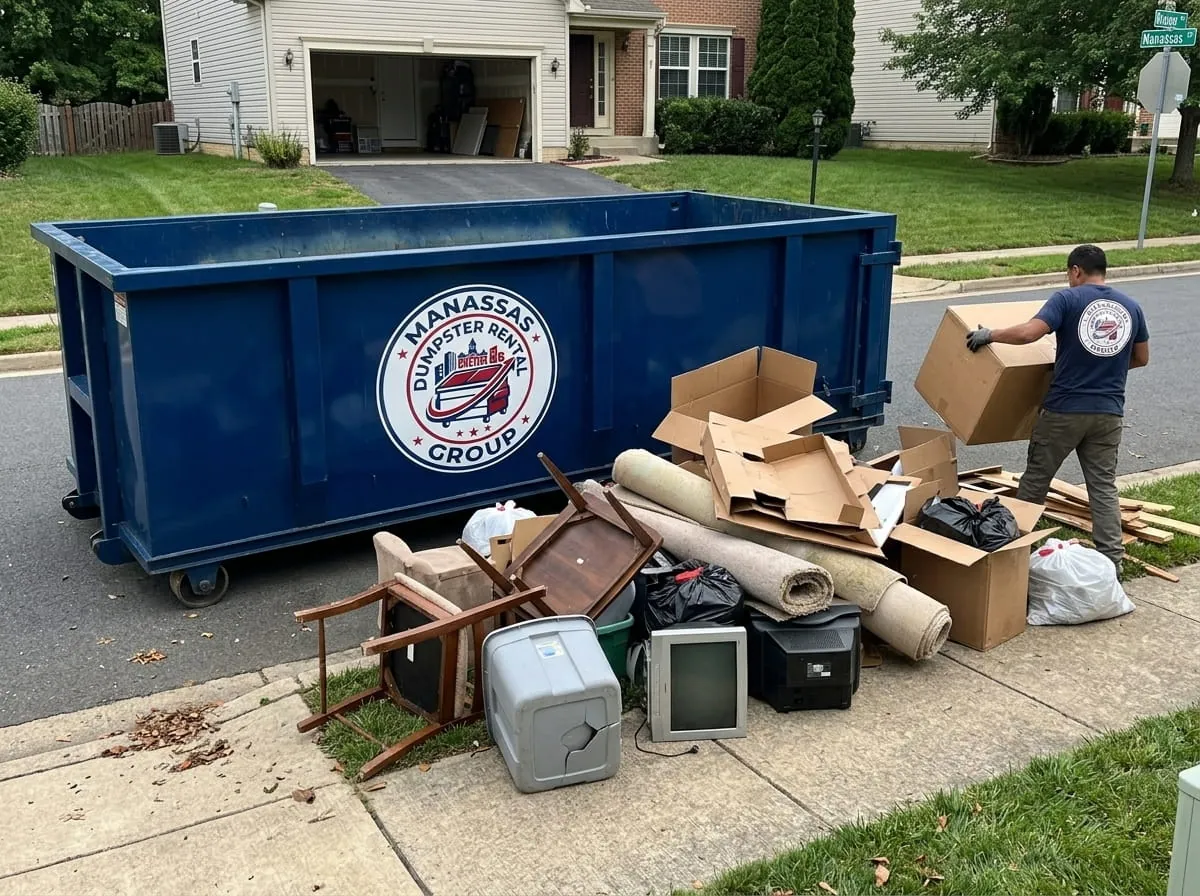
I've been dropping roll-off dumpsters across Manassas and the wider Prince William County area long enough to know that the single most common question I get on the phone isn't about price. It's "what size do I actually need?" And it's a fair question, because getting it wrong costs you real money in one of two directions. Order too big and you pay for air. Order too small and your project grinds to a halt while you wait on a swap-out.
So let's walk through it the way I'd explain it to a neighbor standing in their driveway. We rent 10, 15, 20, and 30-yard roll-offs, and each one has a job it does well. The trick is matching the container to the debris, and understanding that volume isn't the only number that matters. Weight will bite you if you ignore it.
First, what does a "yard" even mean?
When we say a 20-yard dumpster, we're talking about 20 cubic yards of volume. A cubic yard is a cube three feet on every side, roughly the amount of material a standard pickup bed holds when it's filled and heaped. That's the mental model I want you to use for the rest of this guide: one pickup-truck load equals about one cubic yard. It's not laboratory-precise, but it's close enough to plan a job around, and it turns an abstract number into something you can picture.
Here's the rough breakdown by container:
- 10-yard — about 10 pickup loads. Roughly 12 to 14 feet long, sits low to the ground.
- 15-yard — about 15 pickup loads. The tweener size that solves a lot of problems.
- 20-yard — about 20 pickup loads. Our most-requested container by a wide margin.
- 30-yard — about 30 pickup loads. Tall walls, big footprint, made for volume.
The 10-yard: small, heavy, and often misunderstood
The 10-yard is the workhorse for dense, heavy material. I tell people this one is built for weight, not for size. If you're tearing out a bathroom, ripping up a concrete patio, pulling old tile, or clearing out a single room stuffed with junk, this is your container. It sits low, so you're not heaving debris over a five-foot wall, and the compact footprint fits in a tight Manassas townhouse driveway without eating the whole thing.
Where people go wrong with the 10-yard is assuming small means light-duty. It's the opposite. Because concrete, dirt, brick, and roofing shingles are so heavy, you'll usually hit the weight limit long before you fill the box. A 10-yard packed with clean concrete can weigh more than a 30-yard packed with couches. That's by design. Order the 10 for the heavy stuff and the 20 or 30 for the bulky-but-light stuff.
Good fits: single-room cleanout, small bathroom remodel, concrete or dirt removal, a modest deck teardown.
The 15-yard: the problem-solver
The 15-yard doesn't get enough respect. It's the size I reach for when the 10 feels a hair too tight but the 20 feels like overkill. Think a two-room cleanout, a garage that's gotten out of hand, a small kitchen remodel where you're pulling cabinets and countertops, or a mixed load of household junk with some construction debris folded in.
It gives you meaningfully more room than the 10 without the taller walls of the 20, so loading stays easy. If you're on the fence between a 10 and a 20 and your material is a mix of medium-weight stuff, the 15 is frequently the smart middle path that saves you from either paying for empty space or running out of room.
Good fits: two-room cleanout, garage purge, small-to-mid remodel, mixed light construction debris.
The 20-yard: the one most people should order
If you called me and described a typical project without much detail, odds are I'd steer you toward the 20-yard. It's the sweet spot for residential work in Northern Virginia and it's our most popular container for a reason. It holds a genuine amount of material, roughly 20 pickup loads, but the walls are still low enough that most folks can toss debris in without a struggle.
A whole-home cleanout on a modest house? Twenty yards. A flooring job across the main level? Twenty. A mid-size roofing tear-off on an average Manassas single-family home? Often a 20, though watch the weight on shingles. A big garage-and-basement combined declutter before a move? The 20 handles it. This is the container that fits the most jobs with the least drama, which is exactly why we send out more of them than anything else. You can read more about it on our 20-yard dumpster page.
Good fits: whole-home cleanout, flooring removal, mid-size roofing, large decluttering, deck demolition.
The 30-yard: when you truly have volume
The 30-yard is a big box, and it earns its keep on jobs that generate a lot of light, bulky debris. New construction and major additions. Whole-house gut renovations where entire rooms are coming down to the studs. Large commercial cleanouts. Estate clear-outs where decades of belongings need to leave all at once. When you'd otherwise be renting two 20-yards and paying for two hauls, one 30 usually makes more sense.
The walls are tall, so plan your loading. It helps to break down furniture and stack rather than toss, because how you pack a 30 makes a real difference in whether everything fits. What the 30 is not for is heavy material. Never fill a 30-yard with concrete, dirt, or a full roof of shingles unless you enjoy conversations about overweight fees. Heavy goes in the 10. Bulky goes in the 30. Keep those straight and you'll be fine. Details and pricing are on our 30-yard dumpster page.
Good fits: whole-house gut renovation, new construction, large estate cleanout, commercial projects, big landscaping jobs.
Not sure which size fits your job? Call us at (571) 518-5792 and describe what you're clearing out. Two minutes on the phone saves you from ordering the wrong box.
Volume versus weight: the mistake that costs the most
Here's the part nobody tells you until the invoice shows up. Every dumpster comes with an included weight allowance, and that allowance is separate from the volume. You can have plenty of room left in the box and still be over on tonnage. This is where the surprise charges come from, and it's almost always avoidable.
Certain materials are deceptively heavy. Concrete, brick, asphalt, dirt, gravel, and roofing shingles all weigh a ton, sometimes literally, in a surprisingly small pile. That's why we tell customers doing concrete or dirt removal to use a 10-yard and fill it maybe two-thirds. It looks half empty. It's actually near the weight limit. If you'd instead loaded that concrete into a 30-yard, you wouldn't have saved money, you'd have gotten an overweight fee and a container you couldn't legally haul on the road.
The flip side is bulky light material, which is all about volume. Old furniture, mattresses, drywall, cardboard, insulation, general household junk. That stuff fills space fast but barely moves the scale. For those jobs, go big on volume and you'll almost never touch the weight limit. When you call, tell us what the debris actually is, not just how much. The material type drives the size recommendation as much as the quantity does.
Matching size to common jobs
Let me put it plainly, project by project, the way it usually shakes out around here:
- Single-room cleanout: 10 or 15-yard, depending on how packed the room is.
- Whole-home cleanout: 20-yard for most houses, 30-yard if it's a large home or truly full.
- Roofing tear-off: 10 or 20-yard, sized by weight because shingles are heavy. A single-layer average roof often fits a 20; multiple layers or a big roof may need two hauls.
- Kitchen or bath remodel: 10 to 15-yard for one room, 20-yard if you're doing several at once.
- Construction and new builds: 30-yard for the bulky framing and packaging waste, a separate 10 if you've got concrete.
- Estate cleanout: 20 or 30-yard depending on how much has accumulated. These almost always hold more than families expect.
- Concrete, dirt, or heavy demo: 10-yard, every time, and don't overfill it.
Why oversizing wastes money and undersizing stalls the job
Oversizing feels safe. More room, less worry, right? The problem is you pay for the container's capacity whether you use it or not. Renting a 30 to throw away one room's worth of junk means you've paid for 20-plus yards of empty steel to sit in your driveway. That's money you'll never see again, and a bigger box takes more space and sometimes needs a permit it wouldn't otherwise.
Undersizing is the more painful mistake, though, because it stops your momentum cold. You're mid-project, the crew is rolling, and the dumpster is full with half the debris still on the ground. Now you're waiting on a swap-out, paying for a second haul, and the whole job stretches an extra day or two. The demolition guys stand around. The schedule slips. What looked like the cheaper option turns into the expensive one.
The honest answer is that the right size is the one that matches your actual debris with a little breathing room, not a lot. When people genuinely can't decide between two sizes, I usually nudge them toward the larger of the two, because a bit of unused space costs far less than a stalled project and a second delivery fee. But there's no substitute for a quick conversation. Tell us the project, the material, and where it's going, and we'll get you the right box the first time.
The bottom line for Manassas and Prince William County
You don't need to become a dumpster expert. You need to think in pickup loads, respect the difference between weight and volume, and be honest about what you're throwing away. Heavy material goes small. Bulky material goes big. Most homes land on a 20-yard, and when in doubt, size up a notch rather than risk a stall.
If you'd rather just tell someone what you're working on and get a straight recommendation, that's what we're here for. Reach out through our contact page or call and we'll match the container to your job, drop it where you need it, and haul it when you're done. No guesswork, no surprise fees, no oversized box eating your driveway for a week.

Founder, Manassas Dumpster Rental Group — sharing straight advice from more than 15 years of local hauling experience.