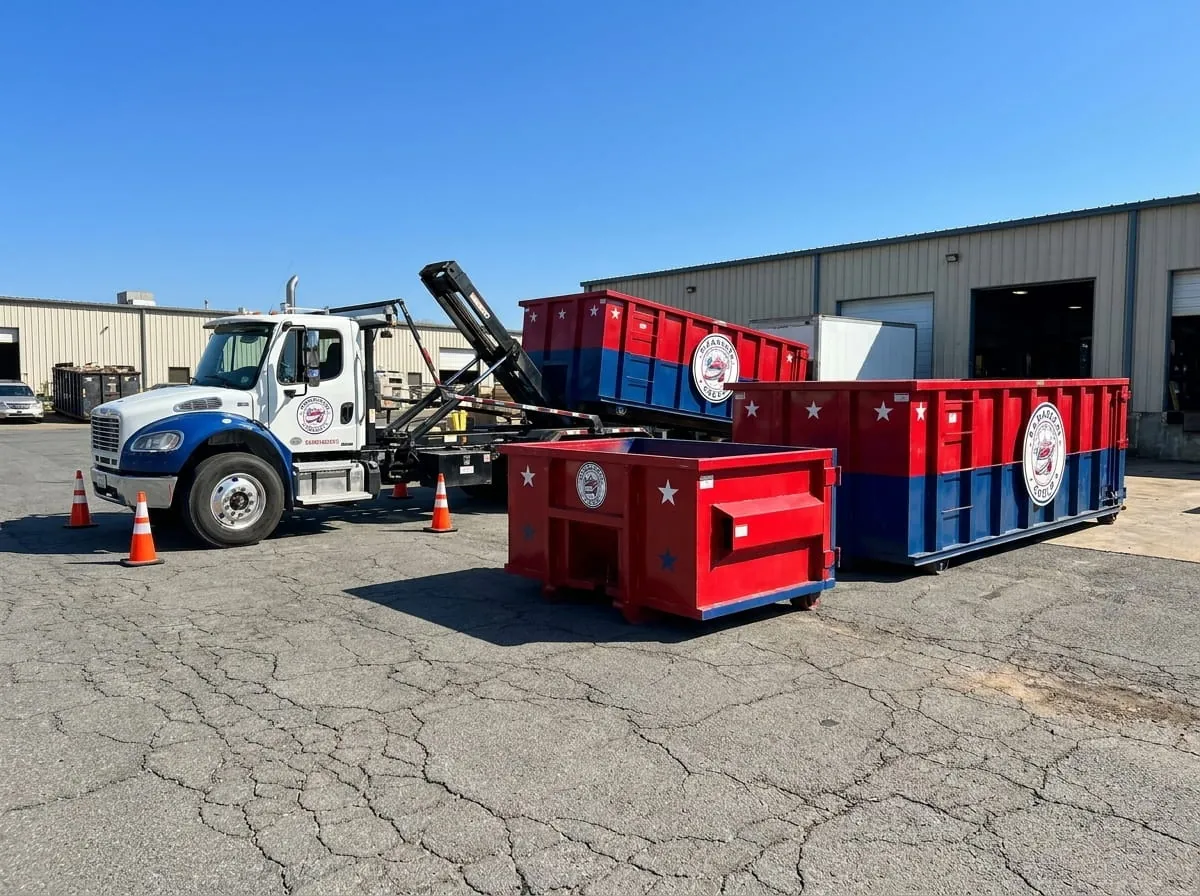
Every roofing crew I've worked with in Prince William County has a story about the tear-off that went sideways because of the dumpster. Either the box filled up at noon on day one and half the crew stood around waiting for a swap, or somebody rented a 20-yarder thinking bigger is always better and then couldn't legally load it past the fill line without going over the axle weight. Roofing debris breaks the normal rules. It's the one job where a smaller container is usually the right call, and the reason comes down to simple math that a lot of folks skip.
Why shingles are so heavy for their size
Here's the thing people underestimate: a pile of torn-off shingles that looks modest weighs a ton. Literally. Asphalt shingles are basically fiberglass mat soaked in asphalt and coated with mineral granules, and asphalt is dense. Wet them down with a summer rain the night before your tear-off and they get heavier still, because the granules and the felt underneath soak up water and hold it.
Roofers measure in squares. One roofing square covers 100 square feet, and it usually takes three bundles of standard architectural shingles to make a square. Now the weights:
- 3-tab shingles: roughly 200 to 230 pounds per square.
- Architectural (dimensional) shingles: roughly 300 to 400 pounds per square, sometimes more on premium lines.
- A single bundle: anywhere from 60 to 80 pounds when you're carrying it up the ladder.
But that's just the shingles. The tear-off weight includes the felt or synthetic underlayment, the old nails, ice-and-water shield, any rotted decking you pull, and the flashing. Add drip edge and ridge cap. Realistically, budget an extra 10 to 20 percent on top of the shingle number for everything else riding along in the pile.
Running the numbers on a real roof
Let's do an actual house. Say you've got a 2,000-square-foot single-story ranch in Manassas with a moderately pitched roof. Between the pitch and the overhangs, the roof surface works out to about 22 squares. One layer of architectural shingles at 350 pounds per square:
22 squares x 350 lbs = 7,700 lbs, or roughly 3.85 tons.
Add the underlayment, nails, and flashing and you're comfortably over 4 tons for a single-layer tear-off on a mid-size home. That fits in a 10 or 15 yard box with room to spare on volume, but you're right in the zone where weight, not space, governs everything.
Now double it. If that same roof has two layers of shingles that were never torn off during the last re-roof, you're looking at close to 8 tons of debris. That's when the size conversation gets serious, and it's exactly why the layer count matters more than the square footage.
Single-layer versus multi-layer tear-offs
The number one question I ask any roofer who calls is: how many layers are coming off? In older Prince William County neighborhoods it's common to find two, sometimes three layers stacked up, because a previous owner had a roofer shingle straight over the old material to save money. Code caps most residential roofs at two layers, but plenty of homes are sitting at the limit or past it.
A single-layer tear-off on an average home fits one 10 to 15 yard container without drama. A two-layer tear-off roughly doubles the tonnage, and now you either need a larger container rated for the weight or you plan on a swap partway through. Three layers is almost always a two-container job. Guess wrong on layers and you'll either pay for a box that goes back half empty or you'll stall the crew waiting for a haul-out you didn't schedule.
The 10 to 15 yard sweet spot
For the overwhelming majority of residential shingle jobs, a 10 or 15 yard dumpster is the right tool. Here's why we steer roofers away from the big 30 and 40 yard boxes even though they hold more volume.
Shingles are so dense that a 20 or 30 yard container full of tear-off would be dangerously overweight for the truck to haul and would blow past legal road limits. You physically cannot fill a large roll-off with shingles all the way up, so you're paying for air you can't use. The 15 yard dumpster hits the balance: it holds enough debris to knock out most single-layer jobs in one pull, its lower walls make it easier to toss shingles in from a ladder or a chute, and it stays within safe hauling weight when loaded with heavy material.
The 10 yard is the pick for smaller roofs, garages, sheds, or when you're doing a partial re-roof and know the tonnage will be modest. Both sizes share the same low profile, which matters more than roofers expect once the debris starts flying off the eaves.
Not sure which size your job needs? Call us at (571) 518-5792 and tell us your square count and layer situation. We'll size it right the first time so your crew isn't standing around.
Driveway placement for roofing crews
Where the box sits decides how fast the tear-off goes. Roofers work best when the dumpster is parked directly below the eave they're stripping, so shingles drop straight in instead of getting hauled across the yard in wheelbarrows. A few things we've learned placing containers for roofing jobs around Manassas:
- Protect the driveway. A loaded roll-off carrying four-plus tons of shingles puts real pressure on the surface. We set boards or plywood under the wheels and load points on request, especially on newer asphalt driveways in summer heat when the surface softens.
- Position for the fall line. Tell us which side of the house you're starting on. We'll spot the box so the bulk of the tear-off lands in or right next to the container, not on the lawn.
- Leave truck clearance. The delivery and swap truck needs a straight, unobstructed approach. Move the cars before we arrive. Overhanging branches lower than about 14 feet will snag the box going up.
- Mind the low walls. The low sides of a roofing box are a feature, but it means debris can bounce out on a hard throw. Keep tarps down around the container to catch stray shingles and nails so the cleanup at the end is quick.
If the driveway genuinely can't take the load or there's no room, we can talk about street placement, though Manassas and some Prince William County HOAs require a permit for a container in the right-of-way. Bring that up when you book and we'll walk you through it.
Scheduling swaps so the crew never stops
The best-run roofing jobs treat the dumpster like part of the crew. On a two-layer tear-off or a big multi-square roof, you don't wait until the box is full to think about the next one. You schedule the swap for the moment the first container hits its fill line, so the truck is pulling the full box and dropping an empty in the same window your crew is breaking for lunch.
Give us a rough timeline when you book. If you tell us the tear-off starts Tuesday at 7 and you expect to fill the first box by early afternoon, we'll have the swap staged. Roofing moves fast once it starts, and nailing debris hauled the same day keeps your site safe and your neighbors happy. Nobody wants a mountain of shingles and exposed nails sitting on the property overnight longer than it has to.
One more scheduling note: watch the weather. A tear-off in progress with rain coming means you want that debris gone and the deck dried in fast. We'll do everything we can to move a swap up if the forecast turns, but the more lead time you give us, the more we can flex.
Loading a roofing box the right way
How the debris goes in changes how much you fit and how safe the haul is. Load heavy and flat: shingles should lie down in even layers across the floor of the box, not get piled up in one corner. An unbalanced load shifts on the truck and can put the whole thing over on one axle even when the total weight is legal. Break up the tear-off into manageable chunks rather than dropping full sheets that trap air pockets and waste space.
Keep the load under the fill line. It's painted on the box for a reason, and with material this dense you'll almost always hit the weight limit before you reach the top edge anyway. Do not toss anything that isn't roofing material into a shingle box. No old lumber piles, no soil, no concrete, and definitely no household junk. Mixed loads can trigger sorting fees at the transfer station and, in the case of anything hazardous, can get a load rejected outright. If you're pulling rotted decking, that plywood rides fine with the shingles, but keep the container to roofing debris and you'll keep the disposal clean and predictable.
A word on nails and cleanup
Nails are the part of a tear-off that comes back to bite you after the box is gone. A single re-roof drops thousands of old roofing nails, and they scatter well beyond the drip line. Run a magnetic sweeper over the driveway, the walkways, and a good margin of the lawn before you consider the job done. Tarps around the base of the container during the tear-off catch most of them, which is why we push crews to lay them down early. A flat tire or a nail in a kid's foot two weeks later turns a good job into a callback nobody wants, and it's entirely avoidable with ten minutes of sweeping.
Booking the right box
The short version: count your squares, confirm your layers, and lean toward the 10 to 15 yard range because weight, not volume, is the constraint on roofing debris. If you're not sure how the math shakes out on your specific roof, that's what we're here for. Our roofing dumpster rental service is built around exactly this kind of job, with weight allowances that make sense for shingles and swap scheduling that keeps a crew productive.
Ready to line up your tear-off? Get in touch with the square count and layer info and we'll get a properly sized container on your driveway when your crew needs it.

Founder, Manassas Dumpster Rental Group — sharing straight advice from more than 15 years of local hauling experience.